Fernanda D'Acosta
24 Jul 2026
The hidden cost of forgetting what was on the screen
Meeting Productivity


Most professionals are ready to hand meeting notes to AI. In a Digiotouch AI survey of 43 professionals across an international audience in November 2024, 69.8% said they would use a secure AI tool that generates meeting notes in seconds, and only about 5% said no. The same people rate good notes highly useful, yet describe writing them as a chore. The demand is there, and the frustration it would remove is real.
In short:
These findings sit inside a wider pattern. Atlassian surveyed 5,000 knowledge workers across four continents and found that meetings were named the single biggest barrier to getting work done, ahead of unclear goals or lack of motivation. Its State of Teams research adds that in organisations with a poor meeting culture, people spend 50% more time in unnecessary meetings than on high-priority work, and that 55% find it hard to track down information they know exists somewhere. So the record of a meeting now carries two jobs at once: it has to show the hour was worth it, and it has to be findable weeks later.
Buyers have clearly gone looking for help with the second job. G2's AI meeting assistants category tracks over 120,000 verified reviews across more than 120 products, which is a large amount of purchasing attention for a category that barely existed a few years ago. What has been missing is a clear read on what professionals actually want such a tool to do. That is what we set out to measure.
These findings come from a Digiotouch AI survey of 43 professionals, run in November 2024 across an international, public audience. Respondents spanned seniority: 7 in top-level roles, 32 in middle-level roles, and 4 in entry-level roles, across functions such as management, analysis, development, and design. One rating question drew 42 responses; every other question drew 43. As with any survey of this size, the numbers are best read as a clear signal of direction rather than a precise population estimate.
Professionals were clear about what a good meeting needs. Asked to name the key elements of a successful meeting, 97.7% pointed to setting clear objectives and 83.7% to having a clear agenda. Well-structured visuals and keeping the group small also featured, but objectives and agenda stood far above the rest. The pattern is telling: people want meetings that are focused and decision-oriented, which is exactly what a good written record is there to capture and carry forward.
97.7% call clear objectives essential to a successful meeting; 83.7% point to a clear agenda. Digiotouch AI survey of 43 professionals, international, November 2024.
People value notes, even while disliking the work of making them. 76.8% rated notes a 4 or 5 out of 5 for usefulness, and almost nobody rated them low. The open-text answers told the other half of the story: respondents described writing notes as tedious, easy to lose focus during, and often poorly structured after the fact. One person called it their worst task. The value is clear, and the manual effort is the problem.
76.8% rate meeting notes 4 or 5 out of 5 for usefulness. Digiotouch AI survey of 43 professionals, international, November 2024.
How Digiotouch AI handles this: the desktop app records in the background without joining the call as a participant, and the summary and action items are generated from the recording itself, combining what was said, what was shown on screen, and the transcript. Nobody has to type while the meeting is running.
This is the clearest result in the survey. Asked whether they would use a secure AI tool that automatically generates meeting notes within seconds, 69.8% said yes, 25.6% said maybe, and only about 5% said no. When we asked why, the reasons clustered around time and focus: it would save the time spent writing notes up, it would let people stay present instead of scribbling, and it would produce a record faster, while memory is still fresh. The hesitations were just as telling. Several respondents wanted assurance on quality and security first, noting that the value depends on the notes being accurate, well structured, and safe to trust with company conversations.
Would you use a secure AI tool that writes notes in seconds? Yes 69.8%, maybe 25.6%, no about 5%. Digiotouch AI survey of 43 professionals, international, November 2024.
How Digiotouch AI handles this: recordings from users in the EU and EEA are stored in the EU by default, and meeting content is never used to train AI models. On desktop, a copy of the video and audio is written to your own computer as the recording happens, so the record does not depend on the cloud alone.
First, what people most want captured. Asked what is vital to have in the notes themselves, respondents rated task delegation highest, with the meeting's objective and agenda items close behind. In short, the record's main job is to make responsibilities and decisions clear.
Asked which assistant features would boost their productivity, respondents put two ideas at the top: linking action items to specific team members, and note templates tailored to the type of meeting. Live transcription and translation also drew strong interest, while automatically generated statistics about time spent in meetings were the most divisive, welcomed by some and dismissed by others.
| Feature respondents were asked about | Interest (relative) |
|---|---|
| Link action items to specific team members | High |
| Note templates by meeting type | High |
| Live transcription | Positive |
| Translation | Positive |
| Automatic agenda generator | Positive |
| Statistics on time spent in meetings | Mixed |
The open-text requests filled in the picture. People asked for integrations with the tools they already use, such as Slack, Google Docs, and Confluence, plus automatic action items and next steps, timestamps tied to each speaker, a warning when a conversation drifts off track, and one clear place to find the exact note they need later. Read together, the wish list is less about transcription for its own sake and more about turning a conversation into organised, assignable follow-up.
How Digiotouch AI handles this: action items are pulled from the recording with assignees and deadlines filled in from the names mentioned in the conversation, defaulting to TBD where nothing was said, and they stay editable afterwards. From there they can be sent on to Asana, Jira, Trello, monday.com, or ClickUp. Live transcription covers 130+ languages and picks up a change of language mid-meeting.
Put together, the survey describes a gap. People value meeting records, dislike making them by hand, and are ready to trust a secure AI tool to do the job, as long as it is accurate, well organised, and safe with their data. They want action items captured, formats that fit the meeting, transcription and translation, and one reliable place to find things later.
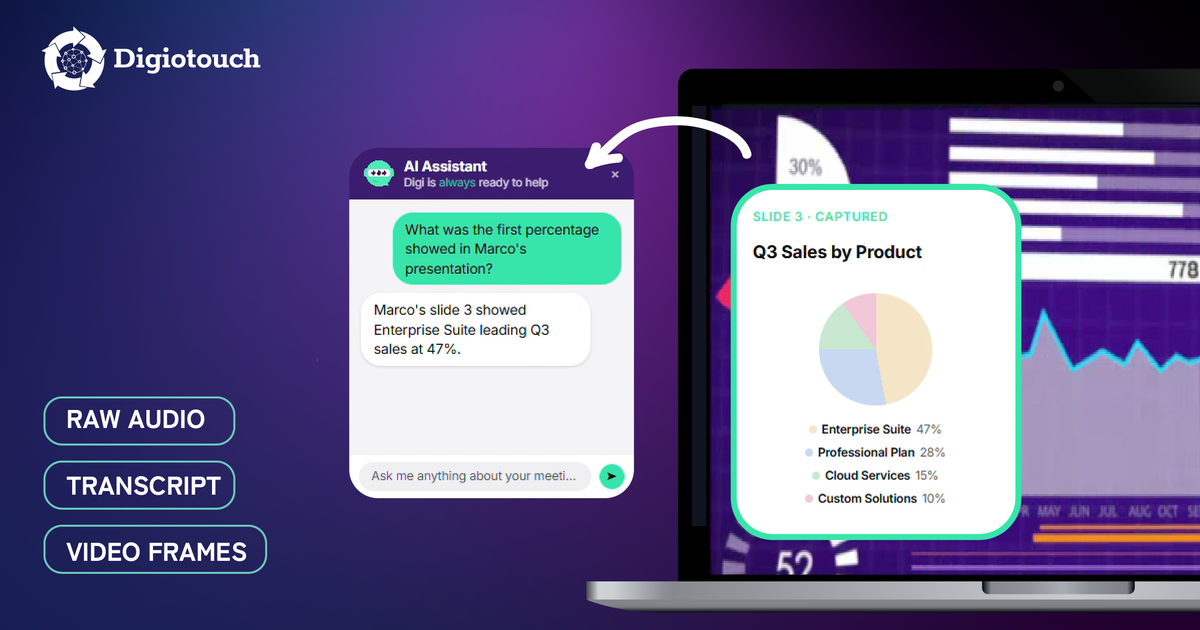
Digiotouch AI is built around that gap. It records the meeting and saves a copy to your own computer, transcribes and summarises in 130+ languages, captures action items and next steps, and connects to the task tools where follow-up actually happens, such as Asana, Jira, and Trello. You can ask its DIGI AI assistant about what was discussed, including content shown on screen during a presentation. It does not train AI on your content, and it offers a free plan to start, so a team can test the idea before paying.
For current plans and prices, see the Digiotouch AI pricing page.
Methodology: an online survey of 43 professionals across an international, public audience, fielded by Digiotouch AI in November 2024, using multiple-choice, rating-scale, and open-text questions. One question received 42 responses; all others received 43. Percentages are rounded, and for multiple-select questions they add to more than 100%. With a sample of this size, figures indicate direction rather than precise population values.
Digiotouch AI is the vendor of the product described above. Survey figures and product details were last checked on 10 August 2026. You can send any corrections to notes@digiotouch.ai.
External sources cited above. All URLs verified live on 17 August 2026.
Yes. In this survey, 69.8% of 43 professionals said they would use a secure AI tool that writes meeting notes in seconds, and only about 5% said no.
In this survey, professionals pointed above all to clear objectives (97.7%) and a clear agenda (83.7%). Good notes are how those objectives and decisions get captured and carried into the next meeting.
Because they value the output but not the work. 76.8% rate notes highly useful, yet describe writing them as tedious and distracting. An AI tool lets them keep the record without losing focus in the meeting.
Assigning action items to specific people and using meeting-type templates rated highest, followed by live transcription and translation. Respondents also asked for integrations, timestamps, and warnings when a conversation goes off track.
People rate notes highly useful (76.8% score them 4 or 5 out of 5) but find writing them a chore, which is the gap an AI tool addresses. Whether it is worth it depends on the accuracy of the output and the security of the data.
Respondents' main condition was trust: accuracy plus data security. Look for tools that are transparent about recording, keep data under clear control, and do not train on your content, and tell participants before you start. This is general information, not legal advice.