Fernanda D'Acosta
24 Jul 2026
Copilot vs Digiotouch AI: how accurate is your meeting transcript, really?
Meeting Productivity

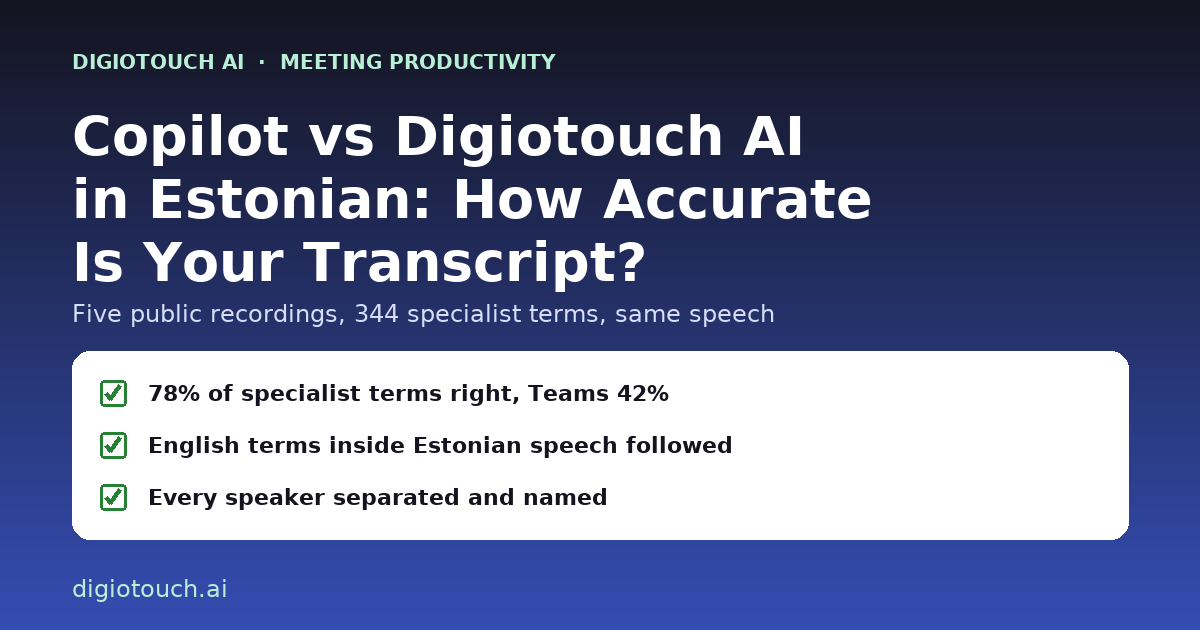
We played five public Estonian recordings, 2 hours 38 minutes in total, into Microsoft Teams and Digiotouch AI at the same time. On the speech both tools transcribed, Digiotouch AI wrote 78% of 344 specialist terms correctly, against 42% for Teams. The widest gap was English terms inside Estonian speech: 56% correct for Digiotouch AI and 8% for Teams. Teams put every word under one person, while Digiotouch AI separated the speakers and named them.
Picture a tech lead at a software company in Tallinn. Her team plans each sprint in Estonian, but half the vocabulary is English: deploy, pull request, compliance, the AI Act. Teams transcribes the call and Copilot writes the recap. When she reads it back, product names have turned into ordinary Estonian words, and every line sits under the name of whoever shared the screen. So she opens the recording and listens again, which is the job the transcript was meant to save her.
A meeting summary is only as good as the transcript under it. If the transcript gets a name, a law or a number wrong, the summary and the action items repeat the mistake.
Estonian makes this harder than most languages. Words change their endings with every case, compounds are written as one word, and specialist talk borrows English terms freely. A tool that hears only one language per meeting will get part of the conversation wrong.
Microsoft Teams lists Estonian among its supported transcription languages and asks you to set the meeting's spoken language to the language people are speaking. Its multilingual speech recognition, which lets each person speak their own language, covers nine languages, and Estonian is not one of them. For a wider look at which tools handle Estonian at all, see which AI note takers work in Swedish, Finnish, Estonian, Latvian and Lithuanian.
We wanted to know what that means for a real transcript. So we repeated our English and French accuracy test in Estonian, with the same method and the same scoring.
Teams followed everyday Estonian reasonably well. It broke down on the words that carry the meaning: specialist terms, names and acronyms. On the same speech, Teams turned 96 of 344 terms into different words. Digiotouch AI did that 29 times.
Some of the Estonian terms Teams changed:
| What was said | Teams wrote | Digiotouch AI wrote |
|---|---|---|
| deterministlikult (deterministically) | Peter ministrit | deterministlikult |
| keelemudelite (of language models) | keele mutualité | keelemudelite |
| PPA (the Police and Border Guard Board) | teeb vea (makes a mistake) | PPA |
| tuumaheidutus (nuclear deterrence) | tundma heidutuse | tuumaheidutus |
| kuude kaupa (for months) | 6 kaupa | kuude kaupa |
| klišee (cliché) | negližee (negligee) | klišee |
| Riigikogu | riigikogu, lowercase all 10 times | Riigikogu, all 10 times |
Compounds were another weak point. Teams split keelemudel (language model) into two words, keele mudel, close to 30 times across the recordings. Digiotouch AI kept it as one word.
How Digiotouch AI handles this: It transcribes from the recording and is built for meetings full of specialist language, so the transcript holds up on names, acronyms and proper nouns, not only on everyday speech. In this test it kept keelemudel as one word and wrote Riigikogu with a capital letter every time.
English terms inside Estonian speech were where Teams struggled most. It got 6 of 72 right (8%). Digiotouch AI got 40 (56%).
A Teams meeting is transcribed in the meeting's spoken language, and its multilingual speech recognition does not cover Estonian. With Estonian selected, Teams heard every English word as Estonian and wrote the nearest Estonian word it knew.
| What was said | Teams wrote | Digiotouch AI wrote |
|---|---|---|
| Anthropic | antropov, andropov, entroopia | Anthropic |
| Google I/O | google you | Google I/O |
| Mac | mäng (game), mägi (mountain) | Mac |
| Codex Security | koodeksi kuradit (the code's devil) | Codex security |
| Gemini 3 | seminari 3 (seminar 3) | Gemini 3 |
| policy | politsei (police), three times | policy |
| compliance | complaints | compliance |
| Slido | sõidu (of a ride) | Slido |
| AI Office | ei pea jõhvis (no need in Jõhvi) | AI Office in 9 of 10 uses |
| JEF (Joint Expeditionary Force) | Tšehhi (Czechia), seven times | JEF |
Even "AI" was a problem. In the talk on lawful AI, Teams did not write it correctly once in 17 uses. "The problem is wider than AI" became "laiem kui hai": wider than a shark.
One podcast episode included a short advert in English. With the meeting set to Estonian, Teams wrote: "Forster. No. Kui NKW. Kiud, salzburgerhof." Digiotouch AI switched language and wrote: "Interview? No. You might want to prepare more. I've got an MBA, 10 years in the field." The advert is not in our scores, but it shows what a fixed meeting language does to a switch.
How Digiotouch AI handles this: Automatic language detection is built in, so there is nothing to set before the meeting. It follows switches between Estonian and English as they happen and transcribes each language as spoken. You can then translate the summary into any of its 130+ languages.
Teams put every line of all five recordings under one name: the tester who shared the screen. In the parliament session, seven speakers took turns asking and answering questions, and the Teams transcript reads as one long monologue. In the lawful AI talk, the moderator's questions run straight into the speaker's answers.
Digiotouch AI separated the speakers from the recording itself and named them in all five recordings. It kept the moderator apart from the speaker, and the two podcast hosts apart from their guest.
It was not flawless. A few short segments had no name or sat under the wrong speaker, most of them in the parliament session, and one podcast host's surname was misspelt. But the transcript showed who asked and who answered, which is what a summary needs to assign the right action to the right person.
How Digiotouch AI handles this: It identifies speakers from the recording itself, using both the video and voice activity, so it can tell people apart in webinars, uploaded recordings and in-person meetings where there are no per-person logins to rely on.
Copilot builds its meeting answers from the Teams transcript, so every error above carries into them. Microsoft also does not list Estonian among the languages supported for intelligent recap in Teams.
That matters most in talks and sprint reviews, where the slides often carry the exact names, figures and terms that the transcript gets wrong. A summary that only hears the sound inherits those errors. We looked at this gap in more detail in the hidden cost of forgetting what was on the screen.
How Digiotouch AI handles this: It is video-first, using audio and video frames together. The summary and action items draw on both the spoken transcript and the on-screen content, so the record reflects what was shown as well as what was said.
Across 344 specialist terms that both tools transcribed, Digiotouch AI was right 78% of the time and Teams 42%. Digiotouch AI scored higher in every recording.
| Recording | Format | Terms scored | Teams errors | Teams correct | Digiotouch AI errors | Digiotouch AI correct |
|---|---|---|---|---|---|---|
| AI news round-up | Podcast, 1 main presenter | 60 | 45 | 25% | 20 | 67% |
| Riigikogu question time | Parliament session, 7 speakers | 94 | 57 | 39% | 17 | 82% |
| Language models | Conference talk, 1 speaker | 51 | 20 | 61% | 1 | 98% |
| Lawful AI | Talk with Q&A, 2 speakers | 52 | 21 | 60% | 6 | 88% |
| EU AI Act | Podcast, 3 speakers | 87 | 56 | 36% | 31 | 64% |
| Total | 344 | 199 | 42% | 75 | 78% |
Source: Digiotouch AI test on five public Estonian recordings, scored against the Riigikogu stenogram, published sources and Estonian spelling rules. A blind re-check of 104 terms agreed on 206 of 208 verdicts.
Errors come in two kinds. A wrong word changes the meaning: Teams made 96, Digiotouch AI 29. A form error leaves the word recognisable but misspelt, split or wrongly capitalised: Teams made 103, Digiotouch AI 46. Counting every term a reader would still recognise, Digiotouch AI reached 92% and Teams 72%.
The two podcasts were the hardest for both tools. They are fast, informal and full of English product names, which is close to how many Estonian tech teams actually talk.
Digiotouch AI made its own mistakes, most of them in the EU AI Act podcast. It heard tehisintellekti (of artificial intelligence) as "teise intellekti" (of the other intellect) four times. It heard AI määrusest (from the AI Act) as "äärmusest" (from extremism) three times. Teams got that term wrong in every use.
Some names beat both tools: the AI Act ("teie aktil" in Teams, "EACTil" in Digiotouch AI), ElevenLabs ("ei lähen. Laps" and "Elven Labs"), ChatGPT ("jätketega" and "chatkega") and the podcast's own name, AIPowerment ("ei apartment" and "AI Powerment"). Whichever tool you use, check new product names and Estonian event names before you share a summary.
The best test is your own meetings. Record your next Estonian meeting with Digiotouch AI alongside your current tool, then compare the names, the English terms and the speakers.
You can start on the free plan, or try the paid plans free for 14 days.
Summaries, action items and follow-up emails are built from the transcript. In Estonian, case endings, long compounds and English terms make errors more likely, and each error carries into everything built on top.
In our test on five public recordings, Digiotouch AI wrote 78% of specialist terms correctly on speech both tools transcribed, and 92% were still recognisable. Teams scored 42% and 72%.
Yes, when the meeting's spoken language is set to Estonian. Its multilingual speech recognition, which lets people speak different languages in one meeting, does not include Estonian. Microsoft also does not list Estonian among the languages for intelligent recap.
Yes. It detects the language automatically and follows switches during the meeting, with nothing to set beforehand. It supports more than 130 languages.
Yes. It separates and names speakers from the recording, including in webinars, uploaded files and in-person meetings.
No. Digiotouch AI does not train AI models on customer meeting content. Data for EU customers is hosted in the EU, and Digiotouch AI is GDPR compliant.
There is a free plan and a 14-day trial of the paid plans. Current prices are on digiotouch.ai/en/pricing.